
Published ·
1948 – 2023: Porsche celebrates 75 thrilling years of sports cars, Driven by Dreams, with a series of events, exhibitions and activities around the world, and in Greece
A close look at the 75 years that created the Porsche legend, at the great figures who shaped its course, at the milestones, the philosophy, the spirit and the vision that brought it to the top and made it the ultimate symbol of material culture.
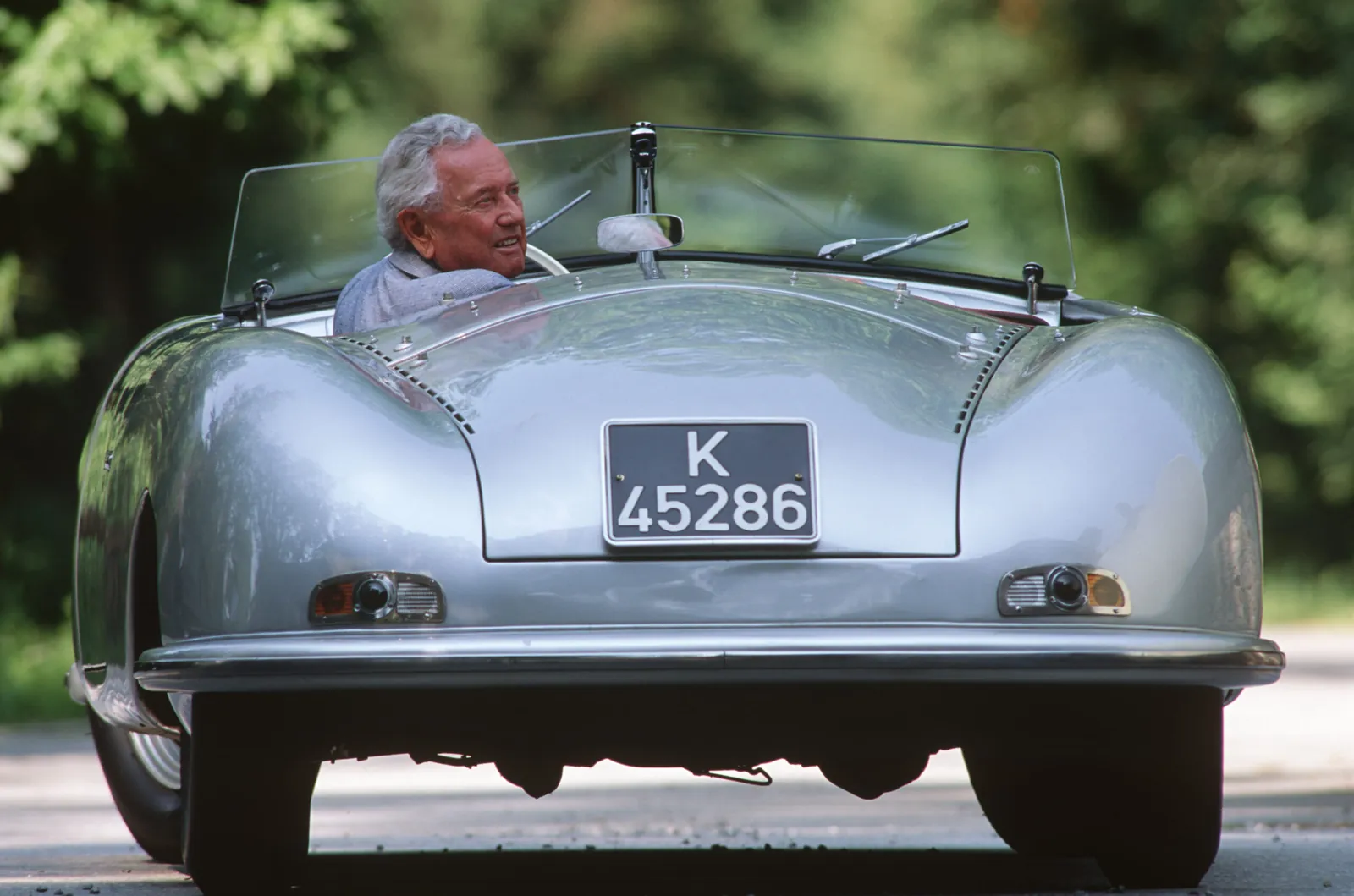
Summer 2023 marks 75 years since the presentation of the Porsche No. 1 Roadster, the first sports car of modern times. It was built in 1948 in Gmünd, Austria, was open-topped and had an air-cooled, four-cylinder flat engine at the rear. The first car to bear the Porsche name had 35 horsepower, which, combined with its weight of just 585 kilograms, gave it a top speed of up to 135 km/h. From the outset, the sports car manufacturer Porsche used motorsport as a platform for testing new vehicles. Thus, on 11 July 1948, the Porsche 356/1 roadster made a fast demonstration lap at the city race in Innsbruck with Herbert Kaes behind the wheel. Since then, a great deal has happened, much of it thrilling, making the Porsche name synonymous with excitement, adrenaline, pioneering spirit, style and innovation.
Porsche is celebrating this year, remembering its heritage and rediscovering itself through a series of special activities and events around the world, while sharing rare photographic material from this wonderful journey with the media. Greece is also taking part in the global 75th anniversary celebration, with a series of events, among which the following stand out:
A gala dinner exclusively for women on the occasion of the 60th anniversary of the Porsche Carrera 911 (1963 – 2023), where Porsche will honour women leaders from various walks of life and individuals who break down barriers and offer inspiration to all women.
A Classic Road Tour, whose spectacular start will take place at OAKA on the morning of 6 May and will be open to the public free of charge, and which will highlight Porsche's heritage.
The renowned “Festival of Dreams”, which will take place on 10 June and will be open to the public, with a series of festive, entertaining and artistic events.
The activities will continue in the second half of 2023 and detailed information will be provided.
A success story full of dreams and challenges The need to realise a dream marked the beginning of Porsche's success story. Ferry Porsche (1909 – 1998), son of the company's founder Ferdinand Porsche (1875 – 1951), had a very clear idea of what a sports car should be. He realised this bold idea in 1948, building the Porsche 356 “No. 1” roadster. The 356/1 roadster received its general operating licence on 8 June 1948. This is also regarded as the birth date of the brand, while the 356 prototype became the first sports car to bear the Porsche trademark. Some people never stop believing in something. So it was with Ferry Porsche, who envisioned modern sports cars at a time when most people were thinking only of the practical vehicles that society needed after the Second World War. As the car of his dreams did not yet exist, he developed it together with his team. This entrepreneurial spirit has characterised Porsche for 75 years, a car manufacturer that continues to reinvent itself without ever losing its values and identity, and without ever abandoning all those elements that brought it this far. Among them, charismatic and visionary people who believed in their dreams and strove to make them a reality hold a central place. This is what Ferry Porsche represented 75 years ago, and it is what Porsche continues to represent today. Manual production of the first vehicles began in the same year (1948). In developing the 356, Ferry Porsche showed that he was not only an excellent team leader and visionary, but also that he was devoted to his design. Building a sports car in the late 1940s required daring. Ferry Porsche had it. With his attitude and his words he opened the company's path to the future. After all, its motto “Driven by Dreams” defines the essence of the brand and implies that visionaries change the world with their foresight and inspiration. Moreover, this phrase reflects the approach adopted every day by the people of Porsche to fulfil the dreams of their customers across the globe, in line with Ferry Porsche's exhortation: “Those who are lucky enough to build a business (that started) from a dream owe it to the world to be the caretakers of dreams.”
The DNA of a company that knows how to evolve Dreams change the world. It has always been so. Ferry Porsche once envisioned a car that had not existed until then. So he built it himself. The founding family managed to preserve what it had originally achieved thanks to its pioneering spirit and courage, its integrity and its down-to-earth attitude. The company always knows how to adapt to the changing demands of the times, while maintaining the essence of the brand. Thus, while every Porsche creation is a typical Porsche, it is also a dream car of the future. The creative approach to the future has always been, and remains, a constant. The people who lead the company and set its course of development understand all this as a perpetual journey of ideas towards the future of mobility. The history of the brand is a source of inspiration again and again, and the creative freedom it offers opens up new, innovative directions. A look back at tradition is always combined with a futuristic plan, with a movement that comes from the future or moves towards it.
From the third generation of the family, Dr. Wolfgang Porsche, shareholder and chairman of the supervisory board of Porsche, the fourth and youngest son of Ferry Porsche and grandson of Porsche's founder, Ferdinand Porsche, comments. “My role is to facilitate good ideas and to protect what has been tried and tested in the past. This is what matters both for the company and for my family.” As a shareholder, Dr. Wolfgang Porsche knows the particular responsibility he bears for the company: “For me, the purpose is to create security in both good and difficult times, so that Porsche continues to be Porsche in the future too.” That is why, although dreams may change from time to time, it manages to be innovative, whether by remaining steady or by questioning everything. Because what matters is that the essence of the brand lives on when these dreams come true. And when what has always distinguished Porsche, the identity of the company, remains unchanged.
Or, as Oliver Blume, Chairman of the Executive Board of Porsche since 2015, vividly describes it: “Porsche is a combination of iconic heritage and modern, sporty luxury. With our sports cars, customers fulfil their dreams.”
Daring, innovation, exploration Technological innovation has been an integral part of Porsche's DNA ever since Ferdinand Porsche surprised the world with fully electric and hybrid vehicles in the late 19th century. The German brand embodies the charm, superior performance and pioneering thinking of the people of Porsche about the future of the automobile. “Optimise the function, reduce the form to the essentials. Go beyond the familiar to continually discover new and better solutions.” Ferdinand Alexander Porsche (1935 – 2012), the firstborn son of Ferry Porsche, created unique designs based on these principles. From the late 1950s, F. A. Porsche headed the team that gave the Porsche 911 its timeless shape. It was first presented as the 901 in 1963, and a year later it evolved into the iconic Porsche 911 that stirs emotion wherever it goes. For Porsche and its people, daring has always been a way of life. Ideas lead the way, competition accelerates their realisation and success is the destination.
In 1972, Ferdinand Alexander Porsche founded Porsche Design together with his brother Hans-Peter. Its first creation was the Chronograph 1, an automatic, matt black, analogue chronograph. This was an innovative and pioneering step at a time when the battery (quartz) prevailed in watchmaking. In the 1970s, the futuristic Carrera 5600 ski goggles surprised people with their flexible panoramic frame, while the Porsche Design P’8478 sunglasses were the first sunglasses with an interchangeable-lens mechanism for different lighting conditions. Porsche Design soon became synonymous with innovative technical solutions, striking design, clear shapes and top quality, and expanded its portfolio with a range of exclusive lifestyle products.
Passion for motorsport Porsche drivers have sought competition and explored the limits of their abilities ever since the first sports cars rolled off the production lines in Gmünd and Zuffenhausen. Porsche tests new motorsport ideas, promotes technical and technological development and cultivates team spirit. As everyone knows, it is now one of the biggest names on racetracks around the world, and legendary drivers have competed with its emblem in rallies and circuits such as Le Mans. The multiple winner Jacques Bernard “Jacky” Ickx, Hans-Joachim Stuck, the pioneering Gilberte Thirion, Walter Röhrl, the indomitable Timo Bernhard, André Lotterer and others went down in history for their “all or nothing” spirit, for never abandoning the fight, and for constantly opening new paths in the most demanding and gruelling conditions. At Le Mans in particular, the greatest and at the same time most important endurance race in the world, where victory is an achievement for drivers and manufacturers alike, Porsche has managed to score a total of 19 wins and is at the top of the manufacturers' list, a true feat based on technical superiority, passion and the Porsche mentality. Indeed, it is the only company that has been present at the famous 24-hour race without interruption from 1951 to the present day.
Dynamism, achievements and courage in sport Porsche's course over these 75 years is intertwined with great athletes who push beyond limits and thrilling sports that raise the adrenaline. The top tennis player Angelique Kerber, who reached as high as No. 1, knew from a young age that she could not have successes without defeats. She worked hard and invested a great deal of time to fight for the top. Without remaining strong, there would have been no progress for Rita Arnaus, world champion in kitesurfing. Earlier, in 1960, Porsche had attempted a spectacular feat, having the then top alpine skier, Egon Zimmermann, jump on his skis over a 356 B. The attempt was crowned with absolute success and the photograph by Hans Truöl became a symbol.
More than six decades later, the image was recreated by Aksel Lund Svindal, the modern alpine skiing champion. “You only have a lot to lose when you are at the top”, notes the two-time World Cup winner, two-time Olympic champion and five-time world champion. The ambassador of the Porsche brand takes part in start-ups pursuing sustainable projects, taking leaps into the future, like all Porsche ambassadors from the field of sport. Then as now, Porsche ambassadors envision the future and make strides of progress despite obstacles. The rising tennis player Emma Raducanu and the wheelchair fencer Oliver Lam-Watson are characteristic examples of the dynamism that Porsche expresses and represents throughout its 75-year journey.
A holistic approach to sustainability With its sustainability strategy, it seeks to promote sustainable development that creates value, while further reducing the environmental pollution caused by its activities. Porsche considers that combating climate change is one of the most important challenges the world currently faces and, as such, the company is working to reduce its carbon footprint to zero by 2030 and envisions a factory with zero impact on the planet. With its sustainability strategy it focuses on reusable materials and recycling-friendly technology, while promoting and supporting the circular economy. For example, with the CASCADE programme, Porsche and Michelin are helping up to 1,000 smallholders on the island of Sumatra, Indonesia, to sustainably source the raw material rubber. But that is not all. It constantly keeps its gaze on the future of mobility, a condition that has the environment, the planet and health as its point of reference. “Electric mobility is a top priority for Porsche. Our ambition is for more than 80% of the vehicles delivered to customers in 2030 to be fully electric. We also think about climate protection holistically and therefore focus on two ‘e’s’: electric mobility and eFuels”, explains the Chairman of the Executive Board of Porsche, Oliver Blume.
Electronic fuels (eFuels) are synthetic fuels produced from renewable sources. They are produced using electricity generated from renewable sources, for example using wind energy, water and carbon dioxide (CO2). The same amount of CO2 is extracted from the atmosphere when eFuels are produced as is released again when they are used by the vehicle. They therefore allow internal combustion engines to operate potentially with a neutral carbon footprint. In December 2022, HIF Global, Porsche and international partners opened their joint pilot plant for the industrial production of eFuels near Punta Arenas, in Chile. The location boasts perfect conditions, as a wind turbine there can produce three to four times more electricity than a wind turbine in Germany. eFuels allow renewable energy to be transported over vast distances, in liquid form, using existing infrastructure. HIF Global, in which Porsche holds a stake, plans to produce more than 550 million litres of eFuel a year in Chile by 2030. It is worth noting that eFuels can be used not only in passenger vehicles, but also in the aviation and shipping industries.
Wholehearted commitment and contribution to society Porsche actively assumes its share of social responsibility. Culture, Sport, Education, Environment and Social Affairs represent the five pillars through which Porsche makes the world a better place for everyone and contributes to creating a fairer society. Among these initiatives, the following stand out, by way of example: The TECHO programme (in Spanish meaning “roof”), through which hundreds of homes have been built in South America and the Caribbean, while at the same time assistance was provided during natural disasters such as the floods in northern Chile in 2015, the 2017 earthquake in Mexico and the eruption of the Fuego volcano in Guatemala in 2018.
The Make-A-Wish programme, in which Porsche takes part by fulfilling the dreams of children facing serious illnesses. At the same time, it supports the foundation of the same name with financial donations.
The PAVE programme, through which Porsche trains disadvantaged young people as highly skilled employees in technical professions, around the world, taking particular account of digital transformation and the rise of electric mobility.
The Turbo for Talent programme, through which Porsche, in cooperation with major clubs, helps up-and-coming athletes (in football, basketball, ice hockey) to develop and excel.
Cultural sponsorships and warm support for the arts Porsche has always supported cultural initiatives that embrace the most refined aspects of Art, and over the years it has been associated with iconic creators and important cultural institutions. For example, the company sponsors the John Cranko school, Germany's first state ballet school, and is also the principal sponsor of the Hamburg Philharmonic, the famous Elbphilharmonie. Meanwhile, with the “Heritage Experience” programme of the Porsche Museum in Stuttgart, the sports car manufacturer wishes to build a bridge to the future, preserve values, interpret things in a modern way and give the new generation the opportunity to understand its origins, craftsmanship and Culture. With the Heritage Experience, the Porsche Museum takes its historic work and the vehicles in its collection around the world and to UNESCO World Heritage monuments.
At the same time, Porsche systematically offers up-and-coming artists and visual artists new channels through which they can communicate their work to the general public. Since the 1960s, the sports car manufacturer has offered a platform to artists who present their love for the brand in their own particular way and create modern works of Art on themes such as the models, racing, speed and design. Through their creative freedom, their personal style and their own values, they connect Porsche with the avant-garde and broaden the popularity of the brand. In this context, artists such as Erich Strenger, Vexx, Arthur Kar, Daniel Arsham and several others have been inspired by Porsche and have created unique works of Art.
- For even more information, high-resolution photographs, visual material, videos, logos, statements, chronologies and stories about Porsche (in English and German), please visit: